Careers That Will Survive the AI Age: 8 Future-Proof Paths Every Student Should Know
By: Javid Amin | 12 November 2026
AI can write essays, debug code and summarise a 100-page report in seconds. So what is left for a student choosing a career today? Quite a lot, as it turns out, and the data points in a clearer direction than the headlines suggest.
Key Takeaways
- The World Economic Forum expects 170 million new jobs and 92 million displaced jobs by 2030, a net gain of 78 million.
- The most exposed group right now is not “everyone”. It is early-career workers whose tasks overlap with what AI does well.
- Careers built on trust, physical presence, judgment and accountability are the hardest for AI to replace.
- The smartest strategy is not to run from AI. It is to pick a human-centred field and learn to use AI inside it.
Is AI Really Coming for Every Job? What the Data Actually Says
Let us start with the numbers, because fear travels faster than facts.
The World Economic Forum’s Future of Jobs Report 2025, built on a survey of more than 1,000 employers across 55 economies, projects that structural change will touch about 22% of today’s jobs by 2030. About 170 million new roles are expected to be created, while 92 million are displaced. That is a net gain of 78 million jobs worldwide.
But the same report is blunt about who gains and who loses. Roles such as postal clerks, bank tellers and data entry clerks are among the fastest-declining. Growth is led by technology roles, and also by care workers, educators and the energy-transition workforce. Employers also say skill gaps are their biggest barrier, with 63% naming it a major obstacle.
Now the sobering part. A Stanford Digital Economy Lab study, “Canaries in the Coal Mine?”, analysed payroll data from ADP through July 2025. It found that workers aged 22 to 25 in the most AI-exposed jobs, such as software development and customer service, saw a 13% relative drop in employment. Older workers in the same fields were stable or even growing. The researchers also noted that jobs where AI assists people held up far better than jobs where AI replaces tasks outright.
Read that carefully. AI is not erasing whole professions. It is quietly shrinking the entry-level rungs of tasks it can do cheaply. For students, that is the real headline.
What Makes a Career “AI-Resilient”?
Before the list, here is a simple four-question test. The more “yes” answers a career earns, the safer it tends to be.
- Does it depend on human trust? Patients, students and clients often need to feel heard by a person.
- Does it happen in the physical world? Hands, tools, sites and bedside care are hard to automate.
- Does it require judgment under uncertainty? Messy, incomplete situations with no clean answer favour humans.
- Does a person have to be accountable? Someone must sign, decide and take responsibility.
With that lens, here are eight careers worth a serious look.
1. Doctors: Where Science Meets Human Judgment
AI is already helping read scans and flag patterns. But medicine is more than pattern recognition. A doctor weighs test results against a patient’s fears, history and circumstances, and carries legal and ethical responsibility for the call.
Demand is also structural. The World Health Organization projects a global shortfall of about 11 million health workers by 2030. A September 2026 WHO release added that nearly one in four doctors across 122 countries is 55 or older and nearing retirement, with 67 countries facing severe staffing gaps.
Student tip: Learn clinical skills first, then add data literacy. Future doctors will work with AI tools, not against them.
2. Nurses and Advanced Practice Nurses: The Heart of Healthcare
Nursing combines technical skill, physical care and emotional presence. It is hard to imagine a chatbot comforting a frightened patient at 3 a.m. or handling a wound dressing.
The US Bureau of Labor Statistics (BLS) projects that nurse practitioners will grow about 40% between 2024 and 2034, making them the fastest-growing healthcare occupation. Physician assistants (about 20%) and physical therapist assistants (about 22%) are also rising quickly. BLS also expects healthcare and social assistance to be the fastest-growing industry sector, and the median wage for healthcare practitioners ($83,090 in May 2024) sits well above the all-occupation median of $49,500.
Student tip: Nursing is a strong base. Specialisations, such as critical care, geriatrics and mental health, add both pay and job security.
3. Psychologists and Mental Health Professionals: Healing Needs a Human
AI can offer prompts and reminders. But therapy depends on the relationship between two people, built on trust, nuance and ethical responsibility. Clients in distress rarely want to be “processed”. They want to be understood.
We could not find a reliable global employment projection specific to psychologists, so we will not quote one. The logic is still strong: rising awareness of mental health, combined with a licensing and ethics framework that keeps a qualified human in charge.
Student tip: Pair psychology with research methods or data skills, so you can evaluate AI-based wellness tools critically.
4. Skilled Engineers: Building and Fixing the Real World
A quick clarification. “Engineer” covers a huge range. Entry-level coding is among the most exposed tasks, according to the Stanford study. Engineers who work with physical systems, such as civil, electrical, mechanical, energy and environmental engineers, are in a different position.
The WEF lists renewable energy engineers, environmental engineers and electric and autonomous vehicle specialists among the fastest-growing jobs. BLS projects the fastest growth of all for wind turbine technicians (about 50%) and solar installers (about 42%), and 28.5% for information security analysts.
Student tip: Whatever branch you choose, build depth in systems thinking, safety and on-site problem-solving. Use AI for drafting and simulation, and keep the judgment for yourself.
5. Teachers: Mentors, Not Just Content Delivers
AI can explain photosynthesis in ten styles. But a classroom is about motivation, discipline, curiosity and care for a child who is falling behind. The WEF names educators among the roles expected to grow by 2030.
Student tip: The best future teachers will use AI to cut paperwork and personalise practice, which frees time for the human parts of teaching.
6. Researchers: Asking the Questions No One Has Asked
AI is excellent at summarising what is already known. Research is about the unknown: choosing which question matters, designing the experiment, noticing the odd result and defending the conclusion. It also demands scientific integrity, which is a human responsibility.
Student tip: Learn your field deeply, then learn how to use AI for literature review and data analysis. Researchers who do both will move faster than those who do either alone.
7. Entrepreneurs: Turning Uncertainty into Opportunity
AI lowers the cost of starting up. One person can now draft a business plan, build a prototype and run a marketing campaign. But spotting a real customer problem, taking risk, persuading people and carrying the consequences are human acts.
The WEF also expects resilience, flexibility, agility and creative thinking to rise in importance by 2030. These are entrepreneurial muscles.
Student tip: Start small while still studying. A side project teaches more about selling and failing than any lecture.
8. Creative Strategists: The Ones Who Decide What to Say and Why
AI can generate a thousand slogans. It cannot easily decide which one fits a brand’s values, a culture’s mood or a risky moment in the market. Creative strategists combine taste, context and business sense.
Tools make content cheap. That makes direction more valuable.
Student tip: Build a portfolio showing your thinking, not just your output: the problem, the insight, the choice and the result.
Quick Comparison: Eight Careers at a Glance
| Career | Why it resists AI | Skill to build now |
|---|---|---|
| Doctor | Accountability and patient trust | Clinical reasoning plus data literacy |
| Nurse | Physical and emotional care | Specialisation and communication |
| Psychologist | Human relationship and ethics | Research methods |
| Skilled engineer | Physical systems and safety | Systems thinking |
| Teacher | Mentorship and motivation | Tech-enabled teaching |
| Researcher | Original questions and integrity | Statistics and AI tools |
| Entrepreneur | Risk and persuasion | Sales and finance basics |
| Creative strategist | Taste and context | Storytelling and strategy |
The Honest Warning: No Job Is Fully Safe
A “safe career” does not mean a “safe task list”. Doctors, teachers and engineers will all see parts of their day automated. And a high-demand field is not a guarantee of a good job. Hiring, funding and pay vary a lot by country and employer.
The real question is not “Will AI take my job?” but “Will someone using AI take the job of someone who is not?” That is why adaptability matters more than any single degree.
How Students Can Future-Proof Their Careers: 5 Practical Moves
- Choose a human-centred field. Health, education, research, energy and creative strategy all score well on the four-question test above.
- Learn AI as a tool. Treat it like a calculator for thinking: powerful, but only when you know what you are asking.
- Build skills AI struggles with. Communication, empathy, ethical reasoning and leadership. The WEF puts analytical thinking, resilience and creative thinking high on the list for 2030.
- Get real-world experience early. Internships, clinics, labs and projects count for more than another certificate, especially as entry-level roles tighten.
- Keep learning every year. The WEF estimates that a large share of core skills, around 39%, will change by 2030.
Frequently Asked Questions
Which careers are safest from AI? Careers built on human trust, physical work, accountability and complex judgment, such as healthcare, teaching, research, skilled engineering, mental health and entrepreneurship.
Will AI replace doctors and nurses? It is unlikely to replace them. AI is more likely to assist with scans, notes and routine tasks. Global shortages, which WHO puts at around 11 million workers by 2030, point to rising demand.
Are IT and coding careers dead? No, but entry-level tasks are changing fast. Students should aim for system design, security, data and domain expertise rather than only routine coding.
What should a Class 12 or first-year college student do right now? Pick a field you can see yourself in for ten years, learn the basics of AI tools alongside it, and build one real-world project or internship each year.
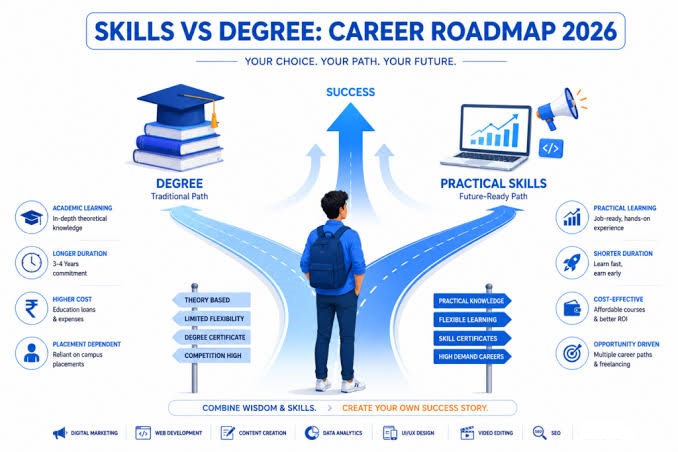
Is a degree still worth it? For regulated professions like medicine, nursing and psychology, yes. For others, a degree plus visible proof of skills is the strongest combination.
Final Thoughts
AI is changing how work gets done, but it is not removing the need for people who care, decide, build and take responsibility. The careers that will survive the AI age are the ones where being human is the product. Choose one of them, learn to work alongside the machines, and you will not be competing with AI. You will be leading it.